
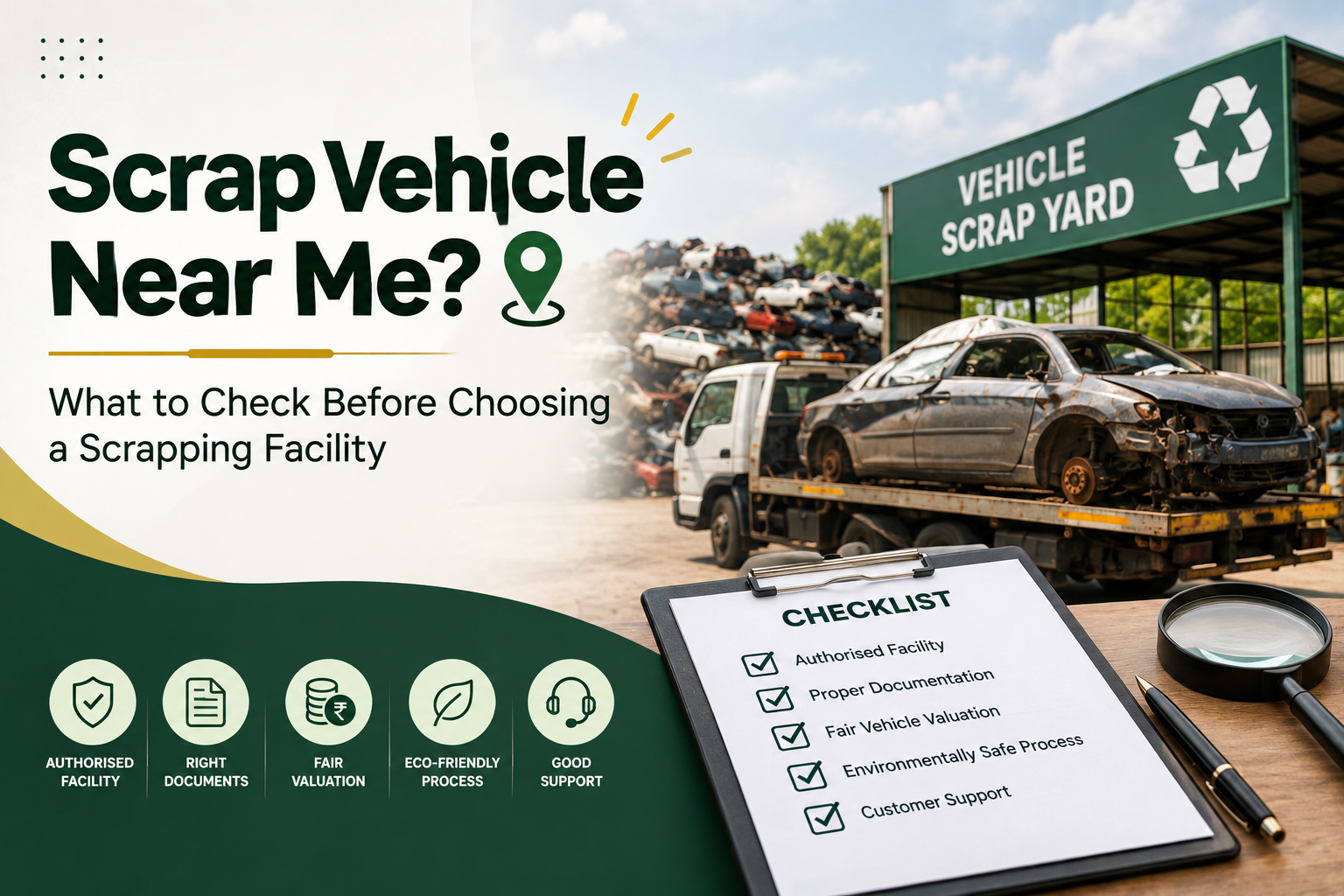
A search for scrap vehicle near me is usually driven by convenience – you want someone close by who can take the vehicle off your hands quickly. That instinct makes sense, but proximity alone doesn’t tell you whether a facility is authorised to scrap your vehicle and issue the paperwork that closes out its registration.
What “Scrap Vehicle Near Me” Actually Means
Distance affects how quickly your vehicle gets collected and whether pickup is free or chargeable. It has no bearing on whether the facility is legally allowed to scrap your vehicle – that depends entirely on whether it’s a Registered Vehicle Scrapping Facility (RVSF).
A facility ten minutes further away that’s properly registered beats one next door that isn’t – the unregistered option can leave your vehicle’s registration active in government records indefinitely.
Genuine Facility or Not? What to Look For
1) RVSF registration. Ask directly whether the facility is a government-registered RVSF and can issue a Certificate of Deposit (CoD). Confirm which transport department they’re registered with and how long the CoD takes.
2) A clear, explainable process. A genuine facility describes each stage without hesitation – see the how it works page for a fair standard. It should explain what happens between drop-off and dismantling, who handles RC deregistration, and what proof you’ll get at each stage.
3) Transparent valuation. Pricing should be based on weight, material, and condition – not a flat number. Ask how the figure was arrived at, and why it differs from other quotes.
4) Safe handling of fluids and hazardous parts. Fuel, oil, and battery components need safe draining before dismantling – see the environmental impact page. Ask whether they follow a documented depollution process or just crush the vehicle as-is.
These four checks separate a compliant RVSF from an informal operator dressed up to look like one.
Did you know? In January 2025, the Ministry of Road Transport and Highways proposed doubling the road tax rebate to up to 50% for owners scrapping older BS-I/BS-II vehicles, up from 25% for personal vehicles and 15% commercial (source: Business Standard). This remains a draft proposal – confirm current rates with your RTO.
Documents Required
- Original Registration Certificate (RC)
- Valid ID proof (Aadhaar, PAN, or similar)
- Insurance details, even if lapsed
- PUC certificate, if available
- Loan NOC, if financed
If the RC is lost, most RVSFs can proceed with a duplicate RC or affidavit, adding a few extra steps.
How the Process Actually Works
- Verification – documents checked against the RC, chassis and engine numbers confirmed.
- Valuation – assessed for weight, material, and condition.
- Pickup or drop-off – depending on what the facility offers.
- Deregistration filing – the facility submits the request to cancel your RC.
- Dismantling – fluids and hazardous parts drained first, then structured dismantling.
- Certificate of Deposit – generated through the government portal once complete.
The full range of services, including pickup and document assistance, is on the services page.
What to Expect on Cost and Certificate
There’s no fixed national rate – what you receive depends on weight, material, condition, and prevailing scrap metal prices, which vary and fluctuate. What matters more than the exact figure is the CoD: the only document proving your vehicle has been permanently scrapped, and what makes you eligible for the tax rebate and registration waivers. None of that is available if the facility wasn’t registered.

Red Flags to Watch For
- Avoids a direct answer on RVSF registration or the CoD.
- Insists on cash-only with no paperwork.
- Quotes an unusually high price with no explanation.
- Can’t say how or when RC cancellation will happen.
- No mention of how fluids or hazardous materials are handled.
If you’d rather work with a facility that handles the whole process transparently, read more about how Global Scrappage Yards operates or check the FAQs page.
Choosing the Right Facility
A “scrap vehicle near me” search will always surface plenty of options, and most will look similar at a glance. The difference that matters is whether the facility is registered and can issue a CoD – everything else, including proximity, is secondary.
Ready to scrap your vehicle the right way? Get in touch with Global Scrappage Yards for a transparent valuation and a registered RVSF that handles pickup through to your Certificate of Deposit.
FAQs
1. Is the nearest facility always best?
No. Proximity affects pickup convenience but not legal authorisation. Registration status matters more than distance.
2. How do I confirm a facility is genuine?
Ask directly whether they’re an RVSF and can issue a CoD. Only RVSFs can legally issue this document.
3. What documents do I need?
RC, owner ID proof, insurance details, PUC certificate if available, and loan NOC if financed.
4. What happens if I use an unregistered facility?
Your vehicle can still be dismantled, but without a valid CoD, its registration stays active indefinitely.
5. What is a Certificate of Deposit (CoD)?
The official document an RVSF issues confirming permanent deregistration and scrapping.
6. Can I scrap without the original RC?
Yes – a duplicate RC or affidavit works, with a few extra steps.
7. What tax benefits do I get?
Up to 25% road tax rebate for personal vehicles (15% commercial), with a proposal under review to raise this to 50% for older, higher-emission vehicles.
Leave a Reply